
How Artificial Intelligence (AI) is Reshaping Litigation Strategy
It’s widely agreed that AI has transformed workplace efficiency and will continue to evolve, yet its darker potential is accelerating, as criminals leverage deep‑fake technology to scale sophisticated fraud operations.
The World Economic Forum describes the scale of this evolution as staggering. Adding on its website: “Deepfake fraud cases surged 1,740 per cent in North America (alone) between 2022 and 2023, with financial losses exceeding $200 million in Q1 2025.”
Deep‑fake technology is now so accessible that it has reshaped how fraud is committed.
Voice cloning now requires just 20-30 seconds of audio, while convincing video deepfakes can be created in 45 minutes using freely available software.
WATCH: IFW GLOBAL AND OUR CRITICAL PARTNERSHIPS WITH LAW FIRMS
AI‑driven fraud and deepfake misuse now represent a new litigation frontier, one where the traditional concept of intent, attribution and liability are increasingly strained.
Unlike conventional fraud, AI‑driven misconduct often lacks a clearly identifiable human actor. Deep‑fake voice and video technology can convincingly impersonate executives, directors, or trusted counterparties, enabling fraudulent transactions that slip past established controls.
IFW Global can track the faceless fraudsters
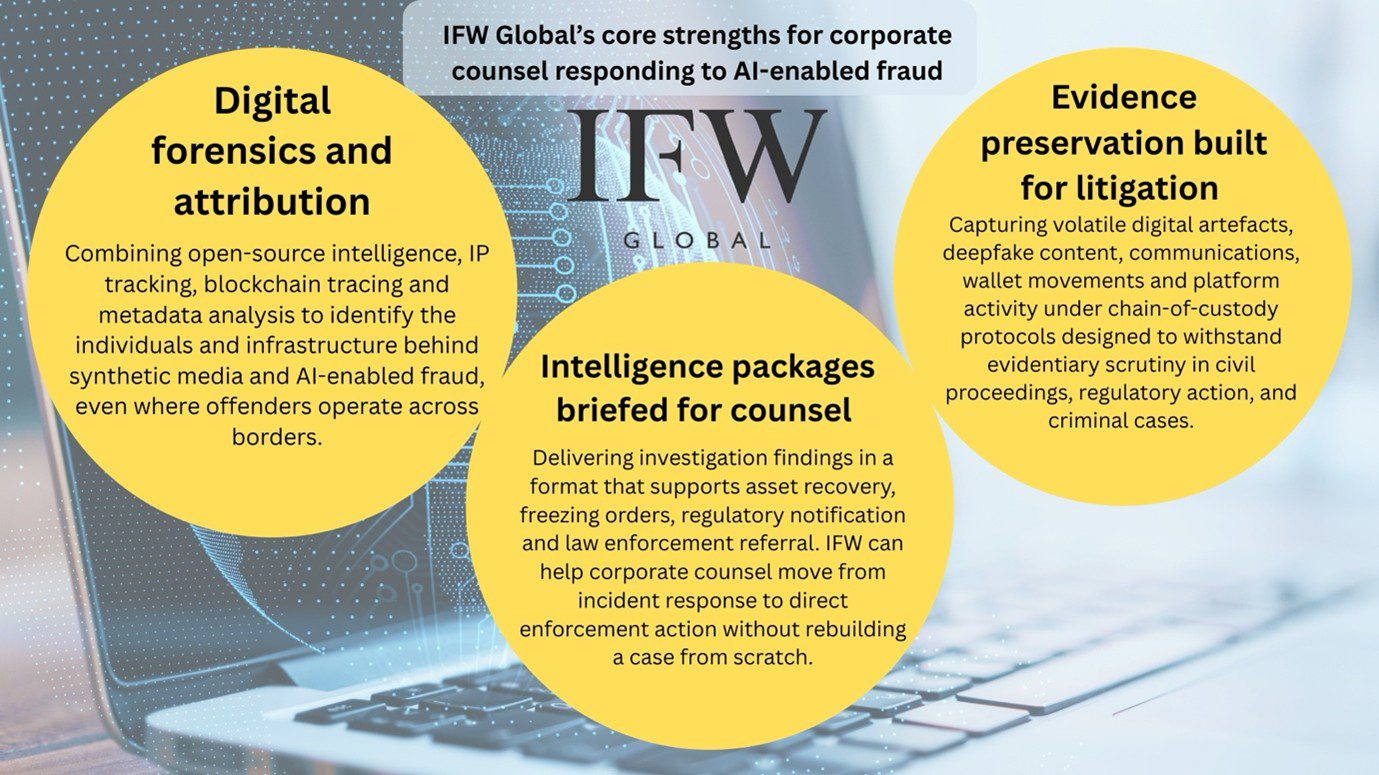
IFW Global’s Director of Global Investigations, Allan Watson, says: “The assumption with deepfake fraud is that the people behind it are untouchable; offshore, anonymous, hiding behind cheap tech. Our experience says otherwise.
“In one recent matter, we traced a series of deepfake videos impersonating Australian Prime Minister Anthony Albanese back to a small North African crew, working from nothing more than a laptop and a mobile phone, yet responsible for luring innocent Aussies into investing with scam platforms.”
Allan Watson adds: “By combining digital forensics with blockchain analysis, the IFW Global team was able to identify the individuals responsible and hand that intelligence to legal counsel for enforcement action in the courts. Geography and a VPN setup aren’t the shield offenders think they are, and that’s what gives corporate counsel and law enforcement something to actually act on.”
Pressure on the court system
Courts are now being forced to assess liability across a fragmented chain that may encompass bad actors, platform providers, software developers and even the victim organisations themselves.
This uncertainty is fundamentally reshaping litigation strategy.
A long a cornerstone of fraud claims, proving intent, is becoming markedly more difficult when deception is automated and executed at scale by AI systems.
WATCH: IFW GLOBAL AND THE CELINE CREMER CASE: FINDING CRITICAL EVIDENCE AGAINST THE ODDS
For corporate counsel, the message is clear: litigation readiness must evolve with the technology. Fraud response frameworks, escalation protocols and risk disclosures need to reflect AI‑enabled threats.
Challenges around attribution further complicate discovery, evidence preservation and jurisdictional analysis. At the same time, regulators are making it clear that uncertainty will not excuse weak governance. AI misuse is increasingly viewed as a core compliance issue rather than a peripheral technology risk, elevating expectations around oversight, internal controls, and board‑level accountability.
As AI‑enabled phishing, impersonation, and synthetic media become more sophisticated, organisations face exposure not only to financial loss but also to regulatory scrutiny, shareholder actions, and reputational harm.
Ultimately, AI‑driven fraud and deepfake risk demand a shift from reactive defence to anticipatory governance. Organisations that fail to adapt may find themselves defending not only against sophisticated fraud, but against claims that they should have seen it coming.


