

Mind Games Behind the Scam Scripts
- Build a persuasive social world around the target
- Surrounding the target with fear
- Greater trust in the perception of authority

In early 2026, Cambodian authorities raided and dismantled a scam compound near the Vietnamese border that was home to more than 2,000 trained workers, many of whom were held captive and forced to work.
Run by an organised Chinese criminal syndicate, the operation generated hundreds of millions of dollars by targeting people around the world through online scams and high-pressure sales tactics known as pig-butchering.
The scale of the operation was alarming, but equally disturbing was the precision with which workers were trained to manipulate their targets.
The raid revealed that cybercrime is not simply a matter of technical hacking, but a highly structured system of psychological and social manipulation.
Criminal groups use specific formulas and strategies tailored to different forms of fraud, including pig-butchering scams, romance scams, investment fraud and Ponzi schemes.
What authorities uncovered demonstrated the sophistication and professional organisation behind these operations, which can trap and exploit millions of victims worldwide.
FAKE POLICE SCRIPT
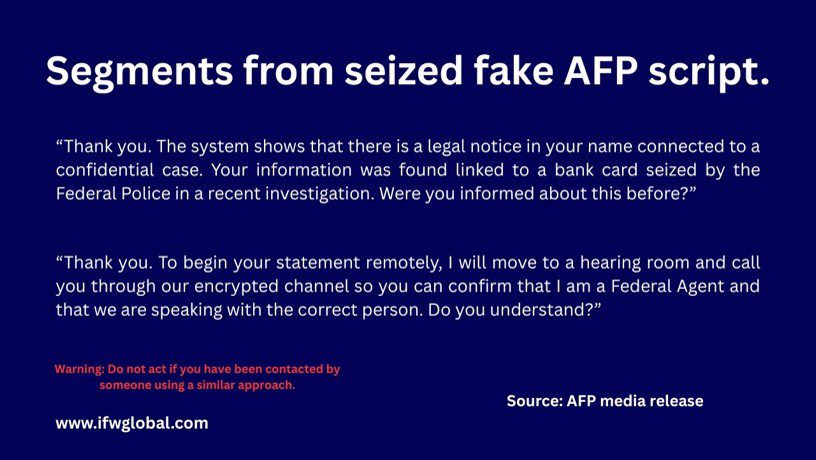
Among the discoveries was a detailed script designed for scammers impersonating members of the Australian Federal Police (AFP). The scammers had even constructed a fake office decorated with fraudulent AFP posters and official-looking materials to create an appearance of legitimacy.

This level of preparation highlights an important psychological principle: people are more likely to trust and comply with individuals they perceive as authority figures.
Social psychologist Stanley Milgram’s research on obedience demonstrated that people often follow instructions from perceived authority figures, even when those instructions conflict with their own judgement.
By presenting themselves as police officers investigating serious crimes, scammers exploit deeply ingrained social norms that encourage cooperation with law enforcement.
Victims are therefore not responding to the scammer alone but to the symbolic power associated with the institution being impersonated. Recent research into scam manuals further demonstrates how organised these operations have become.
Contact IFW Global if you feel you have been the victim of cybercrime
TRAINING MANUALS
A 2026 study published in the Journal of Cybersecurity, titled Fake it till you make it: the psychological and communication tactics behind “Pig Butchering” scams, analysed scam training manuals to show that these operations are built around deliberate psychological instruction rather than improvised deception.
The researchers found that scammers are trained to manage how they appear to victims, create credible identities, and guide conversations through carefully staged emotional and financial escalation.
Rather than simply asking for money, scammers are taught to build a persuasive social world around the victim: they introduce believable personal details, mirror the victim’s interests, offer encouragement and gradually shift the relationship toward dependence and trust.
The study identifies the use of Impression Management Theory, in which scammers construct a trustworthy persona and Social Penetration Theory, in which intimacy is developed slowly through staged self-disclosure. It also connects scam scripts to Maslow’s Hierarchy of Needs and Self-Determination Theory, showing how fraudsters exploit desires for security, belonging, achievement, autonomy and emotional connection.
The Cambodian AFP impersonation script reflects many of these same principles. The fake office, official posters, and scripted interactions function as a form of impression management. Just as pig-butchering scammers carefully construct the image of a successful investor or romantic partner, these scammers construct the image of a legitimate law enforcement officer. The objective is not merely deception but the creation of a convincing social reality in which the victim feels compelled to cooperate.
STRIKING FEAR

Fear is another crucial element in the scammer’s toolkit. Victims are often told that their identity has been linked to criminal activity, money laundering, or other serious offences. These accusations create anxiety and urgency, placing victims under emotional pressure.
When individuals experience stress, their ability to critically evaluate information is reduced, making them more susceptible to manipulation. Scammers intentionally create this state of cognitive overload because emotional responses often override rational decision-making.
Ultimately, the discoveries made during the Cambodian raid reveal that the most powerful weapon used by cybercriminals is not technology but social engineering.
Their success depends on understanding human behaviour, exploiting trust, manipulating fear, and leveraging social structures of authority. Examining these scams through sociological and psychological perspectives helps explain why they remain effective despite increasing public awareness and technological safeguards. Modern scam compounds function not simply as criminal enterprises, but as sophisticated organisations dedicated to studying and exploiting human behaviour itself.
Useful links:


